
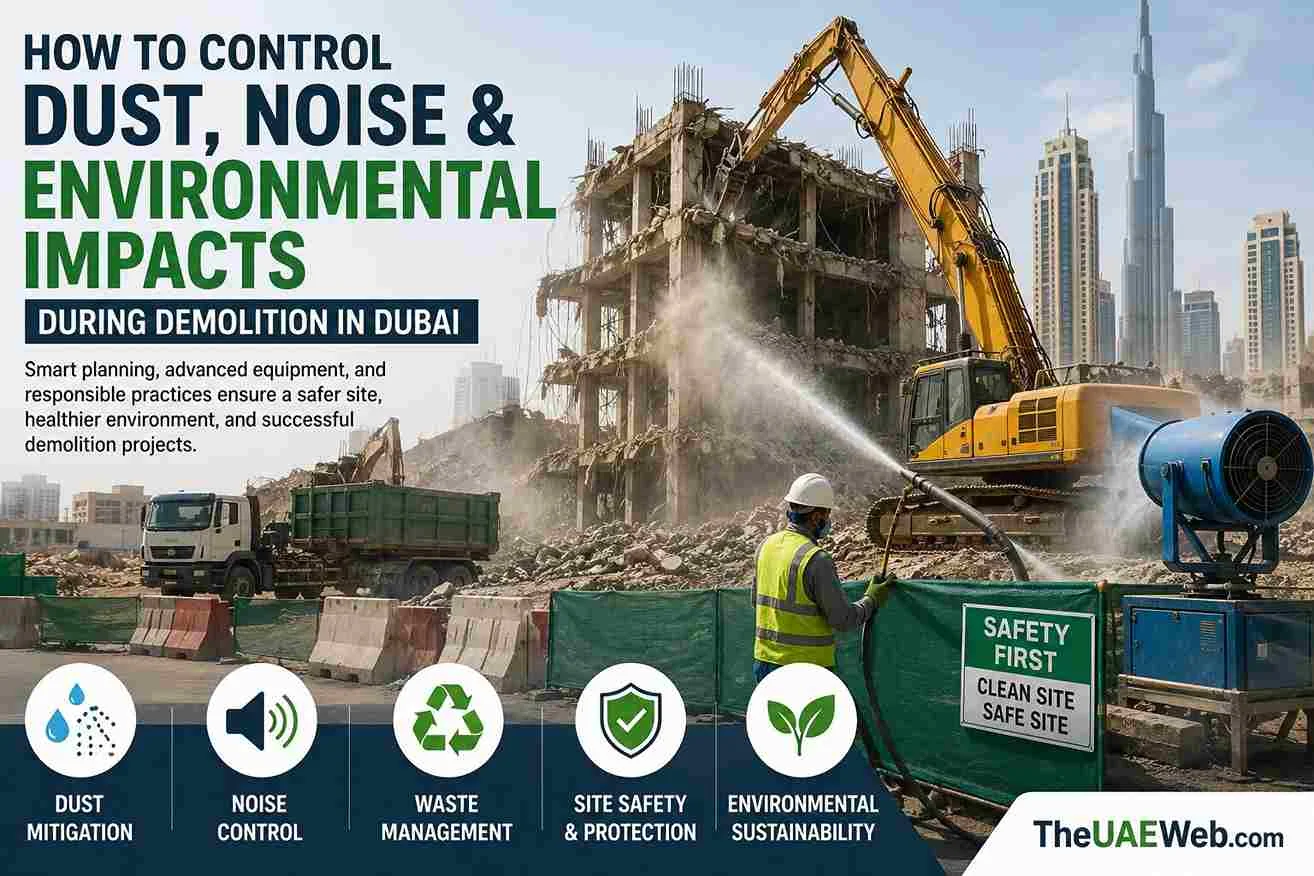
How to Control Dust Noise and Environmental Impacts during Demolition in Dubai
The control of dust, noise, and environmental pollution is necessary for a safe and efficient demolition in Dubai. Experienced contractors make use of dust mitigation systems, demolition processes, management of construction waste, and site safety practices in order to protect employees, neighbors, and the environment. These efforts reduce project risks, promote sustainable construction practices, and facilitate a more efficient project implementation process.
Demolition is no longer seen as the simple act of dismantling a building. Regardless of whether one demolishes residential villas, commercial buildings, industrial buildings, or reinforced concrete structures, dust, noise, vibration, debris, and construction waste are always generated in the course of any project. Professional demolition services Dubai incorporate advanced equipment, experienced engineers, and carefully planned environmental control measures to minimize disruption while maintaining productivity and site safety.
Why Environmental Control Matters During Demolition in Dubai
Environmental management is one of the most important components of demolition planning today. Good control helps decrease risks to health, improves work conditions, ensures the safety of infrastructure surrounding the area, and contributes to making redevelopment more efficient and environmentally friendly.
Demolition services in Dubai incorporate environmental planning throughout the entire process of demolition, starting with site inspections and assessment of possible dangers at the pre-demolition stage. Contractors identify environmental risks, determine proper demolition technologies, and take preventive measures even before starting their activities.
Understanding the Impact of Dust, Noise, and Debris:
Every demolition activity produces dust, noise, debris, and construction waste. If the proper planning and engineering measures are not taken, these effects can have an impact on the nearby communities, workers at the construction site, surrounding infrastructure, and ongoing construction activities.
Common environmental impacts include:
- Reduced air quality around the demolition site
- Limited visibility for equipment operators and workers
- Dust migration onto neighboring properties
- Noise disturbances affecting nearby businesses and residents
- Debris spreading beyond designated work zones
- Increased maintenance requirements for nearby facilities
Protecting Workers, Neighbors, and Surrounding Properties:
The professionally managed demolition site is secure for everyone involved in the demolition process, including the demolition team and even the surrounding community. Environmental controls reduce dangers, thus making the working conditions better and safer.
Key benefits include:
- Improving air quality within the work area
- Reducing workers’ exposure to airborne dust
- Minimizing noise disturbance for nearby communities
- Preventing dust accumulation on surrounding buildings
- Protecting roads, vehicles, and public spaces from debris
- Maintaining safer working conditions across the project site
Supporting Safe and More Sustainable Construction Projects:
Environmental control in modern demolition is significant in achieving sustainable development in Dubai. Environmental protection is interrelated with the efficient use of resources, proper waste disposal, and good construction practices.
Responsible demolition planning helps contractors:
- Reduce unnecessary environmental pollution
- Increase recycling and material recovery
- Improve resource efficiency
- Minimize landfill waste
- Support green building initiatives
- Enhance long-term project sustainability
Common Environmental Challenges During Demolition Projects
Every demolition job comes with its own set of environmental issues based on the size of the building, building material, demolition method, neighboring development, and location of the project. Identifying these risks during the planning stage allows contractors to select appropriate equipment, environmental controls, and demolition safety measures before demolition activities begin.
Awareness of such issues at the planning stage makes it easier for the contractor to choose the correct machinery and environmental controls as well as demolition procedures before any demolition work commences. This ensures safety and efficiency of the demolition Dubai process. This proactive approach ensures that controlled demolition Dubai projects remain safe, compliant, and environmentally responsible.
Dust Generated from Concrete, Masonry, and Cutting Operations:
One of the key issues related to demolition in Dubai includes airborne dust, which is very important from an environmental perspective. Activities related to reinforced concrete, bricks, blocks, and asphalt can produce tiny particles that may travel long distances.
Major sources of dust include:
- Reinforced concrete demolition
- Masonry wall removal
- Concrete slab cutting
- Surface grinding
- Asphalt breaking
- Structural crushing
- Material loading and transportation
Many modern contractors now utilize advanced cutting methods that generate less dust and improve precision before structural dismantling begins. Learn how the use of the latest concrete cutting technologies in Dubai helps improve safety, accuracy, and environmental performance on demolition projects.
Noise Produced by Heavy Demolition Equipment:
Heavy machinery plays an important role in carrying out the demolition process, but at the same time, it can be seen as one of the main causes of noise pollution. There are various techniques of demolition that create different amounts of noise pollution. Professional contractors develop detailed operational plans that balance productivity with effective demolition noise control, ensuring that high-noise activities are carefully managed throughout the project.
Common noise-producing equipment includes:
- Hydraulic excavators
- Hydraulic breakers
- Concrete crushers
- Diamond wire saws
- Floor saws
- Jackhammers
- Wheel loaders
- Dump trucks
Best Practices for Dust Control During Demolition
Effective demolition dust control begins well before demolition equipment arrives on site. Good projects involve the use of engineering control, monitoring of the environment, housekeeping, and good site management practices aimed at reducing dust in all stages of demolition. Dust control in demolition does not involve a single method but involves the use of several dust control methods for better results. These best practices not only reduce environmental impacts but also improve project efficiency, support regulatory compliance, and demonstrate a commitment to sustainable demolition principles across Dubai’s construction industry.
Using Water Suppression Systems to Reduce Airborne Dust:
Water suppression remains one of the most effective engineering solutions for controlling airborne dust during demolition activities. Modern suppression systems capture fine particles before they spread throughout the surrounding environment.
Common water suppression methods include:
- High-pressure misting systems
- Water spray cannons
- Mobile water tank units
- Hand-held spray hoses
- Fine mist nozzles
- Automated sprinkler systems
Installing Dust Screens and Protective Site Barriers:
The physical containment system is another level of protection, as it ensures that there is no contamination of dust and debris outside the area under demolition. The physical containment system becomes extremely crucial in situations where the demolition site is situated near other buildings or structures. When combined with water suppression systems, these barriers significantly improve environmental control during demolition by reducing dust migration and enhancing overall site safety.
Common containment measures include:
- Heavy-duty dust screens
- Scaffold-mounted protective curtains
- Debris netting
- Temporary perimeter fencing
- Covered waste chutes
- Designated material containment zones
Effective Noise Control Strategies for Demolition Sites
Noise management is a fundamental component of responsible demolition in Dubai, especially when such projects involve proximity to residential areas, commercial complexes, hospitals, schools, and operational businesses. Although the use of heavy equipment is an important part of the process, too much noise pollution may interfere with the activities of nearby sites.
Selecting Equipment Designed for Lower Noise Levels:
Advanced demolition tools are manufactured in such a way that they offer higher productivity levels without emitting more noise than old ones. Selecting appropriate tools for the job ensures better efficiency as well as minimizes disruption to the environment around.
Professional contractors commonly utilize:
- Hydraulic excavators with advanced noise insulation
- Low-noise hydraulic breakers
- Diamond wire saws for precision concrete cutting
- Hydraulic crushers instead of traditional impact methods
- Well-maintained generators and compressors
- Equipment fitted with noise-reducing exhaust systems
Regular inspections help maintain optimal performance while supporting effective demolition noise control.
Installing Temporary Acoustic Barriers:
Acoustic barriers act as a good option when there is demolition work that is being undertaken adjacent to any building where people live or work.
Common noise-control barriers include:
- Portable acoustic panels
- Sound-insulated temporary fencing
- Noise-absorbing site enclosures
- Scaffold-mounted acoustic curtains
- Temporary timber hoarding with sound insulation
Environmental Management Practices That Improve Demolition Projects
Professional contractors integrate construction waste management into the demolition process from the earliest planning stages. By identifying recyclable materials and establishing organized waste-handling procedures, projects become safer, more efficient, and environmentally responsible.
Waste Segregation before Material Removal:
Sorting materials before large-scale demolition begins significantly improves waste management efficiency and increases recycling opportunities.
Typical materials separated include:
- Reinforced concrete
- Structural steel
- Aluminum components
- Copper wiring
- Timber
- Glass
- Plastics
- Mechanical and electrical equipment
Recycling Concrete, Steel, and Reusable Materials:
Modern sustainable demolition focuses on recovering valuable construction materials instead of sending everything to landfill.
Materials commonly recycled include:
- Crushed concrete for road base and backfilling
- Structural steel for metal recycling
- Aluminum framing systems
- Copper pipes and electrical cables
- Asphalt pavement
- Selected reusable building components
How Professional Demolition Contractors Deliver Cleaner and Safer Projects
Demolition specialists know that protecting the environment must come much earlier than when the demolition equipment is ready for operation. This process includes thorough planning and engineering evaluation to determine any risks that might be present.
Experienced demolition contractor Dubai teams typically provide:
- Comprehensive site inspections
- Structural and engineering assessments
- Environmental risk evaluations
- Controlled demolition planning
- Dust and noise monitoring
- Waste management coordination
- Continuous site safety supervision
- Final site clearance and recycling management
Benefits of Proper Dust, Noise, and Environmental Control During
The implementation of environmental controls benefits the owners of the projects, the construction companies, the nearby community, and even future projects in the long term. Apart from being compliant with the regulations, it improves project effectiveness and enhances construction quality.
Key benefits include:
- Improved air quality around demolition sites
- Enhanced worker health and demolition safety measures
- Reduced disturbance to neighboring properties
- Better protection of surrounding infrastructure
- More efficient construction waste management
- Increased recycling and material recovery
- Lower environmental impact
- Improved project organization and productivity
- Stronger support for sustainable demolition
- Safer redevelopment for future construction projects
Partner with Arasar International for Environmentally Responsible Demolition in Dubai
Every good demolition job entails environmental responsibility. With the aid of state-of-the-art demolition equipment and best practices, Arasar International ensures a safe, effective, and environmentally friendly demolition service in Dubai. If you’re planning a residential, commercial, or industrial demolition project, our specialists can help you develop a safe, compliant, and cost-effective demolition strategy tailored to your site requirements. Book a consultation today by calling +97145751871 or visit arasarinternational.ae to discuss your project with our demolition experts.
Frequently Asked Questions (FAQs)
- How is dust controlled during demolition in Dubai?
Professional contractors employ water suppression, dust screens, protective barriers, controlled demolition, and constant environmental monitoring in order to minimize dust during the demolition process.
- What causes the most noise during demolition?
Hydraulic breakers, concrete crushers, excavators, jackhammers, and concrete cutting machinery are responsible for producing the noise during the demolition process.
- Why is waste segregation important during demolition?
It helps to improve recycling efficiency, decreases environmental impact, minimizes the need for landfills, and promotes sustainable construction methods.
- What is controlled demolition?
Controlled demolition in Dubai refers to the demolition that is done according to a detailed plan of action in order to minimize the dust, noise, vibration, and other negative impacts on adjacent properties.
- Why should I hire a professional demolition contractor in Dubai?
A professional contractor has everything to ensure safe, efficient, and environmentally friendly demolition.
Direct Contact Channels:
Corporate Email: info@arasarinternational.ae
Head Office Hotline: +971 4 575 1871
24/7 Project Operations: +971 55 797 0010
